Researcher profile

Antoine Gournay

Antoine Gournay contributes to research discovery and scholarly infrastructure.

ResearcherAffiliation not importedOpen to collaborate

Trust snapshot

Quick read

Trust 19 - UnverifiedVerification L1Unclaimed author
5works
0followers
7topics
1close collaborators

Actions

Decide how to stay connected

Follow researcher0

Identity and collaboration

How to connect with this researcher

Claiming links this public author record to a researcher profile and unlocks direct collaboration workflows.

Log in to claim

Direct collaboration

Open a focused conversation when the fit is right

Claim this author entity first to unlock direct invitations.

Research graph

See the researcher in context

Open full explorer

Inspect adjacent work, topics, institutions and collaborators without jumping out to a separate graph page.

Building this graph slice

BZPEER is loading the nearby papers, people, topics and institutions for this page.

Published work

5 published item(s)

preprint2019arXiv

On Critical nets in $\mathbb{R}^k$

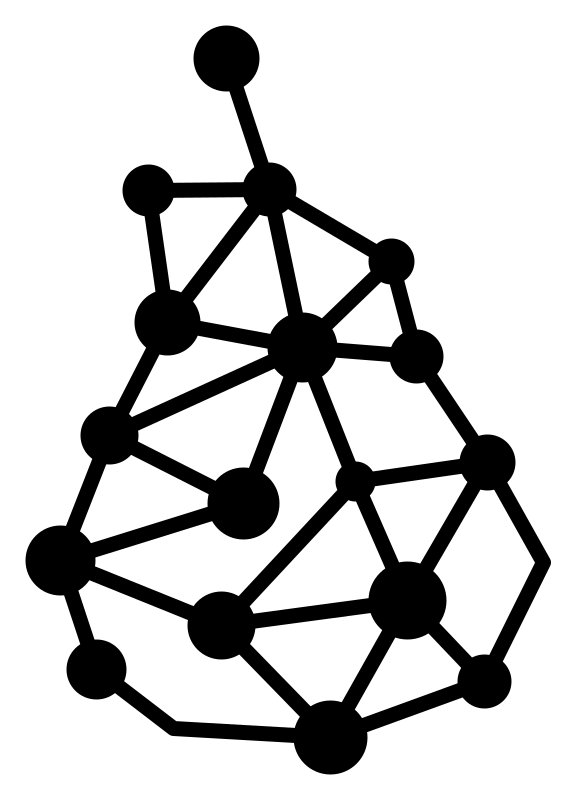
Critical nets in $\mathbb{R}^k$ (sometimes called geodesic nets) are embedded graph with the property that their embedding is a critical point of the total (edge) length functional and under the constraint that certain 1-valent vertices (leaves) have a fixed position. In contrast to what happens on generic manifolds, we show that, if n is the number of 1-valent vertices, the total length of the edges not incident with a 1-valent vertex is bounded by rn (where r is the outer radius), the degree of any vertex is bounded by n and that the number of edges (and hence the number of vertices) is bounded by nl where l is related to the combinatorial diameter of the graph.

preprint2015arXiv

Boundary values, random walks and $\ell^p$-cohomology in degree one

The vanishing of reduced $\ell^2$-cohomology for amenable groups can be traced to the work of Cheeger & Gromov. The subject matter here is reduced $\ell^p$-cohomology for $p \in ]1,\infty[$, particularly its vanishing. Results showing its triviality are obtained, for example: when $p \in ]1,2]$ and $G$ is amenable; when $p \in ]1,\infty[$ and $G$ is Liouville (in particular, of intermediate growth). This is done by answering a question of Pansu assuming the graph satisfies an isoperimetric profile. Namely, the triviality of the reduced $\ell^p$-cohomology is equivalent to the absence of non-constant bounded (equivalently, not necessarily bounded) harmonic functions with gradient in $\ell^q$ ($q$ depends on the profile). In particular, one reduces questions of non-linear analysis ($p$-harmonic functions) to linear ones (harmonic functions with a restrictive growth condition).

preprint2012arXiv

A Runge approximation theorem for pseudo-holomorphic maps

The Runge approximation theorem for holomorphic maps (U -> C) is a fundamental result in complex analysis. The aim of this article is to prove such a result for (pseudo-)holomorphic maps from a compact Riemann surface to a compact (almost-)complex manifold M under certain assumptions. Though the setting is definitively that of pseudo-holomorphic maps it also covers some complex varieties.

preprint2008arXiv

Width of l^p balls

We say a map f:X \to Y is an ε-embedding if it is continuous and the diameter of the fibres is less than ε. This type of maps is used in the notion of Urysohn width (sometimes referred to as Alexandrov width), a_n(X). It is the smallest real number such that there exists an ε-embedding from X to a n-dimensional polyhedron. Surprisingly few estimations of these numbers can be found, and one of the aims of this paper is to present some. Following Gromov, we take the slightly different point of view by looking at the smallest dimension n for which there exists a ε-embedding to a polyhedron of dimension n. While bounds are obtained using Hadamard matrices, the Borsuk-Ulam theorem, the filling radius of spheres, and lower bounds for the diameter of sets of n+1 points not contained in a hemisphere (obtained by methods very close to those of Ivanov and Pichugov). We are also able to give a complete description in dimension 3 for 1 \leq p \leq 2.