Correlation-diversified portfolio construction by finding maximum independent set in large-scale market graph
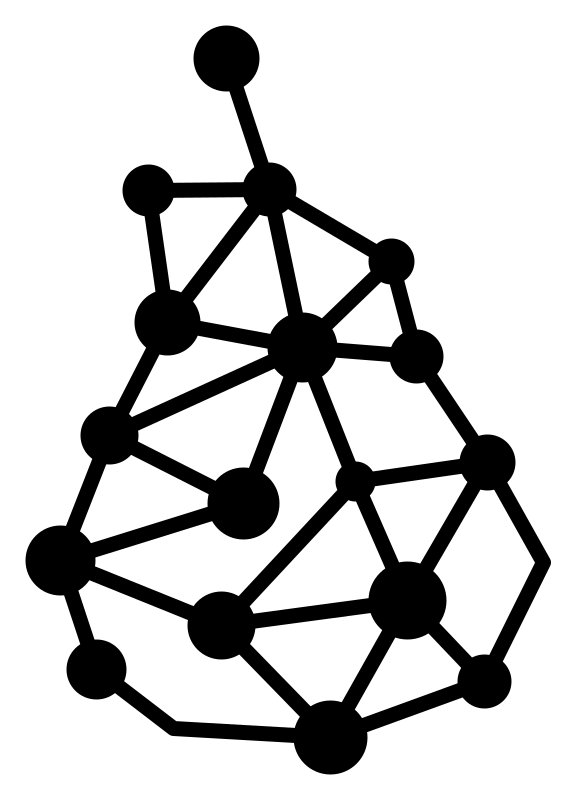
Correlation-diversified portfolios can be constructed by finding the maximum independent sets (MISs) in market graphs with edges corresponding to correlations between two stocks. The computational complexity to find the MIS increases exponentially as the size of the market graph increases, making the MIS selection in a large-scale market graph difficult. Here we construct a diversified portfolio by solving the MIS problem for a large-scale market graph with a combinatorial optimization solver (an Ising machine) based on a quantum-inspired algorithm called simulated bifurcation (SB) and investigate the investment performance of the constructed portfolio using long-term historical market data. Comparisons using stock universes of various sizes [TOPIX 100, Nikkei 225, TOPIX 1000, and TOPIX (including approximately 2,000 constituents)] show that the SB-based solver outperforms conventional MIS solvers in terms of computation-time and solution-accuracy. By using the SB-based solver, we optimized the parameters of a MIS portfolio strategy through iteration of the backcast simulation that calculates the performance of the MIS portfolio strategy based on a large-scale universe covering more than 1,700 Japanese stocks for a long period of 10 years. It has been found that the best MIS portfolio strategy (Sharpe ratio = 1.16, annualized return/risk = 16.3%/14.0%) outperforms the major indices such as TOPIX (0.66, 10.0%/15.2%) and MSCI Japan Minimum Volatility Index (0.64, 7.7%/12.1%) for the period from 2013 to 2023.